
Arrest Warrants in Mohave County
An arrest warrant is a court instrument. Arizona guidance lets a judge issue one after a sworn statement supports a reasonable belief that the named person committed an offense. That is the probable-cause showing. The warrant stays in force until arrest or appearance. Only a judicial officer in the originating jurisdiction can quash or cancel it. That ownership rule shapes every Mohave County arrest warrant check. The Mohave Courts search and the Arizona DPS search are only leads. They are not certificates of present status. A court can restrict a record, a public portal can lag, and confidential case information can be omitted. The clerk or judicial officer for the named court confirms what is active and which procedure applies.
Probable Cause for Mohave County Arrest Warrants
A.R.S. § 13-3897 governs the felony route. For a Mohave County arrest warrant under this statute, a magistrate may issue on a sworn or affirmed affidavit that establishes probable cause. The statute also requires prompt appearance before an accessible magistrate. That affidavit step separates a real warrant from a casual allegation or an unverified portal entry. The official statutory source shows the governing language:
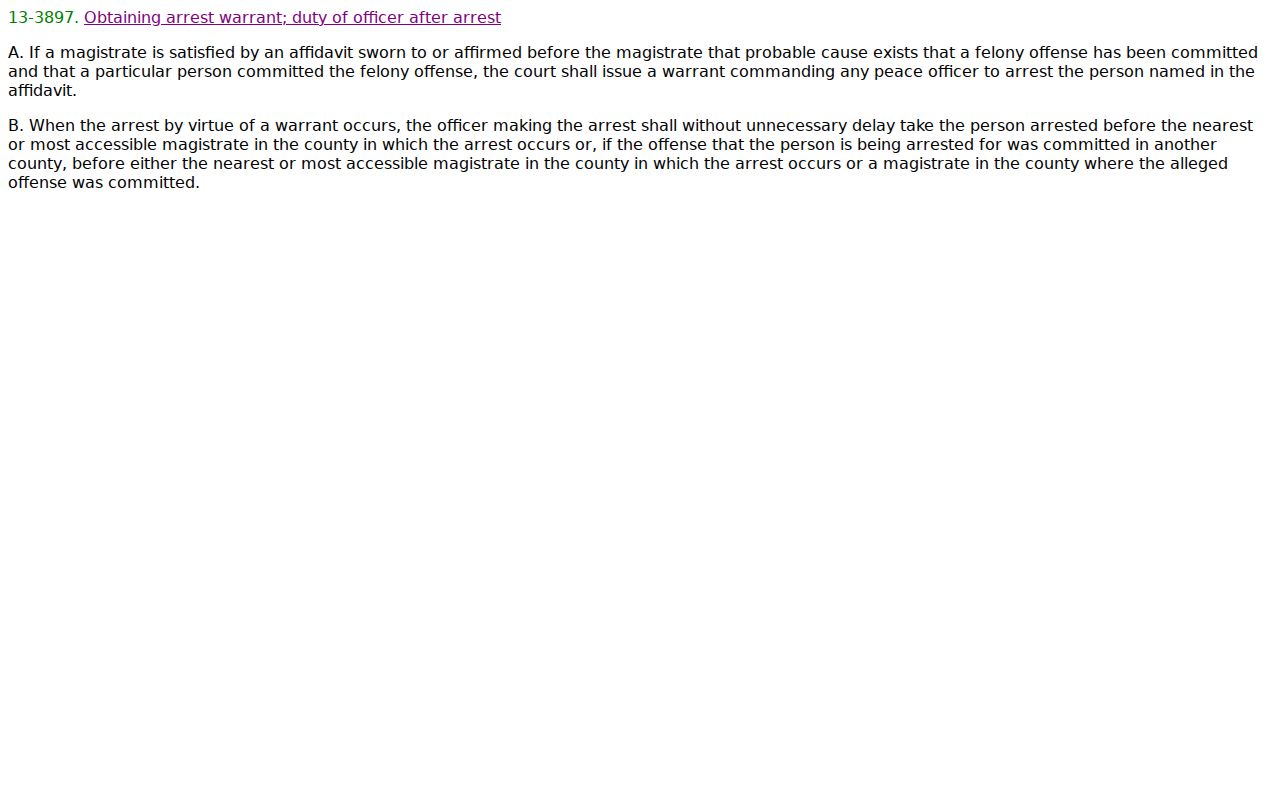
Read the full Arizona arrest-warrant statute for its scope. It governs issuance, not whether a specific Mohave County warrant is public, sealed, active, recalled, or shaped by later case events.
What a Mohave County Arrest Warrant Contains
A public result can route your question. It does not open the complete judicial file. Mohave Courts displays fields such as name, date of birth, Court, Warrant Date, and Case Number. The Court and Case Number matter most. They point to the office that owns the record. The site warns that confidential case information keeps its list from showing every active warrant.
- Person identifiers
- Name and date of birth used to distinguish similar identities.
- Issuing court
- The Mohave County court that controls status and recall questions.
- Warrant date
- The date shown for the judicial order, subject to court confirmation.
- Case number
- A court identifier, such as CR-CASE, useful when contacting the clerk.
- Current status
- Not safely inferred from a public row alone; confirm it with the court.
That Mohave County row is a pointer only. Minutes, filings, later orders, and access restrictions may add context a warrant search never shows.
Four Mohave County Arrest Warrant Questions
That question folds several issues into one. Splitting them prevents a call to the wrong Mohave County office and cuts the risk of relying on stale warrant data.
- Does a court record exist? Search the county and state tools, then identify the court.
- Is the warrant still active? Ask the issuing clerk because portals may lag or omit confidential cases.
- Is the person in custody? Use the Adult Detention Center or official inmate route, not just a court search.
- What happens at appearance? Ask about the docket, judge, counsel, bond, payment, and approved remote options.
These are procedural questions about a Mohave County warrant. Each one has a different office and a different answer.
How Mohave County Arrest Warrants Are Served
Law enforcement serves the warrant. The issuing court, not the officer, controls its judicial status. The Mohave County Sheriff's Office leads county enforcement. City police handle enforcement within their roles. Constables serve court documents and enforce judge orders in justice-court precincts. No agency in that list is the issuing authority for a warrant. The public Mohave County Sheriff's Office page posts agency contacts. Its curated Most Wanted page is not a full warrant inventory. The county court search is the better first route. When an officer serves a warrant, the case moves into custody and prompt court-review procedures. Service alone does not close the case. Do not try personal enforcement. A person checking a possible Mohave County warrant in their own name should ask the court or counsel about the safest approved way to appear. A relative checking on custody should use the official jail contact and the issuing court.
Court Record, Arrest Report, or Custody
Warrant status, arrest records, and custody sit in different channels. The court owns the warrant and the case. MCSO Records handles requests for deputy reports, CAD notes, 911 audio, body-camera footage, photographs, and other incident materials. The Adult Detention Center answers custody questions in Mohave County.
| Question | Best official route | What it does not prove |
|---|---|---|
| Is a warrant active? | Issuing court clerk | A police report cannot certify recall. |
| What happened during an arrest? | MCSO or city police records | An incident file may not show current court status. |
| Is someone detained now? | Adult Detention Center | A warrant-search row does not prove custody. |
| What court action is next? | Issuing court and counsel | The jail cannot independently cancel a warrant. |
Incident records can be withheld. Redactions happen for active investigations, victim privacy, or another legal limit. A records request gets a document; it never replaces a live warrant-status call to the Mohave County court.
Serving Mohave County Arrest Warrants Locally
Go court first, custody second. If a court confirms an active Mohave County arrest warrant and the person is not detained, ask how to appear before you travel. Mohave County courts publish different procedures. Kingman Municipal Court takes warrant walk-ins Tuesday at 9 a.m. Lake Havasu Justice Court accepts weekday walk-ins during its stated hours. Lake Havasu Municipal Court describes business-hours review for warrants and jail commitments. Bullhead Municipal Court splits failure-to-pay warrants from the rest. Full payment may quash a qualifying failure-to-pay warrant. Other warrants require an appearance before a judge. A written request for remote appearance may be available for some other warrants, but approval is required. Confirm before assuming any of these applies at a different Mohave County court.
Confirm before travel: an active warrant appearance can result in arrest, so ask the issuing court about counsel, proof, scheduling, and custody risk first.
Arrest Warrant vs Summons vs Bench Warrant
Mohave County courts use three different tools to bring a person before a judicial officer. A summons just orders an appearance. A bench warrant usually follows a missed duty inside an existing case. An arrest warrant, by contrast, begins with a sworn showing of probable cause and authorizes arrest.
| Instrument | Typical basis | Immediate task |
|---|---|---|
| Arrest warrant | Sworn probable cause | Confirm status, appearance, counsel, and custody procedure. |
| Summons | Order or notice to appear | Follow the date and instructions before default. |
| Bench warrant | Failure to appear or comply | Ask the originating court about recall and compliance. |
| Search warrant | Probable cause tied to a described search scope | Use search-warrant law and the court file, not an arrest lookup. |
A.R.S. §§ 13-3915 and 13-3918 govern search warrants: probable cause, execution, and return. They do not describe an ordinary Mohave County arrest warrant.
Sealed Mohave County Arrest Warrant Records
Some Mohave County warrant records sit behind lawful walls. Sealed materials may come back redacted or withheld entirely. Confidential case information, juvenile records, Orders of Protection, mental-health records, victim or witness data, and certain family or probate materials fall in that group. A.R.S. § 8-208 sets its own juvenile-record access rules. The public-records baseline in A.R.S. § 39-121 does not override those protections. Mohave Courts also warns that confidential information leaves its warrant list incomplete. Arizona DPS says its data is not real-time, current, active, or complete. Arizona Public Access updates on a stated weekly cycle and leaves some categories out. Arizona eAccess is a Superior Court document portal with its own sealed and case-type limits. So a missing row can reflect scope, timing, confidentiality, or a search detail. Treat a blank result carefully. It is not formal clearance. Check the spelling and date of birth you entered. Search the right court first. Then ask the clerk what public confirmation the court can give, and never try to bypass access controls or compile person-level records into a public roster.
Mohave County Arrest Warrant Bond and Release
Arizona court guidance brings an arrested person before a judicial officer within 24 hours for release and bond consideration. What happens then depends on the case. Mohave County publishes no countywide bond table covering every warrant. The charge, the originating court, the warrant's terms, prior appearance history, custody status, and any judicial order can all matter. A fine, a bond, and a traffic collection hold are three different things. A fine is money owed under a judgment. Bond is a release condition a judicial officer sets. A TTEAP registration-renewal hold is administrative and is not automatically an arrest warrant. Paying one category does not satisfy another. The Adult Detention Center sits at 501 W Historic Highway 66 in Kingman, reachable at (928) 753-0759. Bullhead Police says the city has no jail. It routes custody questions to the Mohave County Jail. No office posts universal bond-window hours, accepted instruments, or an online countywide bond vendor. Verify with the jail and the court before sending funds.
What to Do About Your Mohave County Arrest Warrant
A confirmed warrant calls for careful, direct coordination. The court can explain its procedure. An Arizona attorney can advise on legal consequences. Remember the limit, though: a prosecutor, a police desk, a records vendor, or a sheriff employee cannot independently promise that a court warrant has been cancelled.
- Use the Mohave Courts search and Arizona DPS as leads, then record the named court and case number.
- Call the issuing clerk to confirm whether the warrant is active and ask about the approved appearance route.
- Ask about counsel, public-defender eligibility, bond, and documents before appearing.
- If detained, contact the Adult Detention Center and issuing court as separate steps.
- After court action, request direct confirmation of recall, the next date, and expected portal update time.
The Mohave County legal-office directory lists the County Attorney, the Public Defender, and the Legal Defender. Each office routes people within its role. Only the judicial officer can quash the warrant. For the bigger picture, see the Mohave County warrant records overview, which explains how the court, sheriff, and jail fit together.
Federal Arrest Warrants Outside Mohave County Systems
A federal case with a Mohave County tie does not run through the county warrant search or Arizona DPS. Mohave County sits in the District of Arizona's Prescott Division. Federal case documents live at the district court and on PACER. The U.S. Marshals Service District of Arizona handles federal enforcement contacts. PACER charges fees. It is a docket and document research system, not a simple warrant-status check. CourtListener's RECAP collection offers contributed documents free. But it is incomplete and unofficial. A federal warrant can also stay sealed before service or indictment. So a blank free source proves nothing. Take enforcement questions to the Marshals district contact. Mohave County has no separate marshals office. Use the District of Arizona clerk whenever you need a docket verified. Keep the federal and county routes distinct, especially when a Kingman proceeding location is involved.
Mohave County Arrest Warrant Access Changes
Arizona's 2025 administrative-order sequence reshaped pre-charge arrest-warrant access, then reversed itself. Administrative Order 2025-170 came in September. A related order followed later that month, and Administrative Order 2025-220 in December rescinded the earlier sequence. The first order dealt with affidavit, probable-cause, and unique-identifier procedures. The official order index documents the dates.
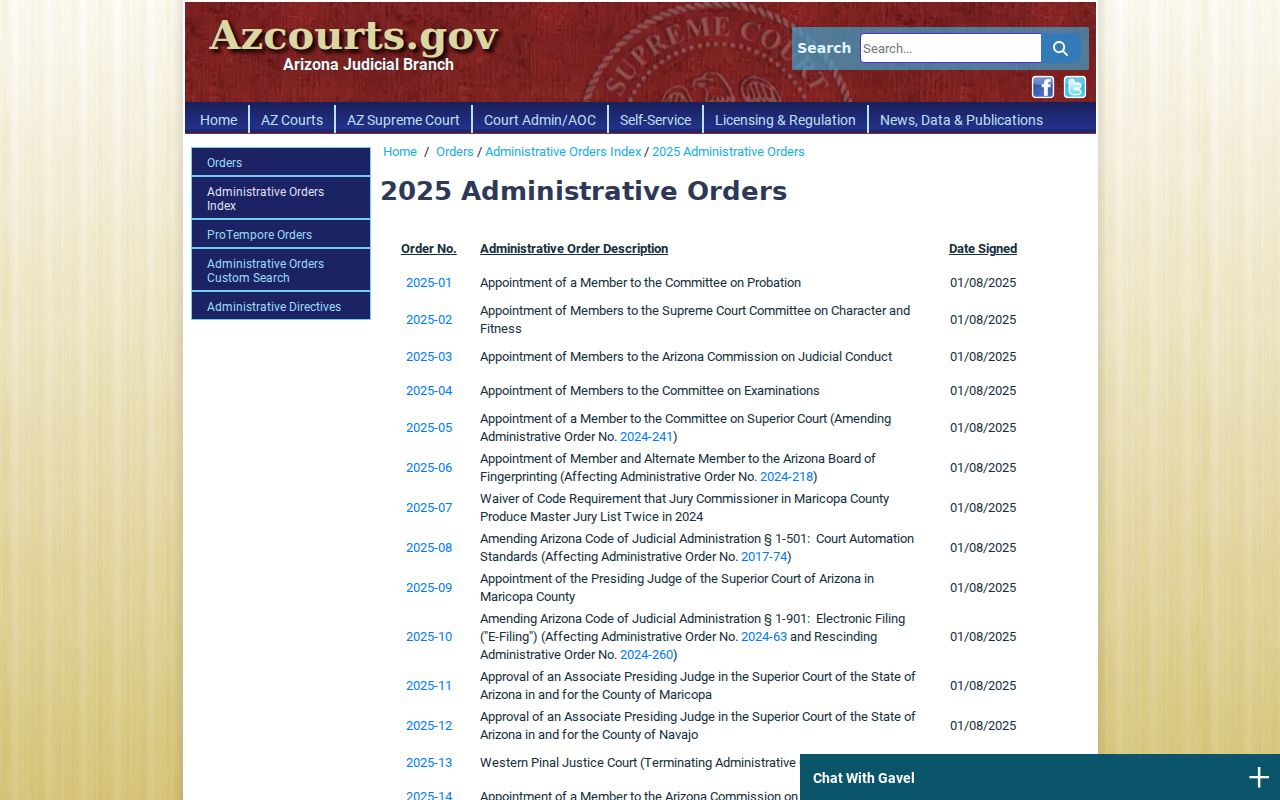
Rules can change. Before trusting any claim about current pre-charge disclosure, check the Arizona administrative-order index and ask the court about its present access rule. Ask the court directly. Past reform does not make a specific affidavit or warrant public today.